A fake proof of address often reveals itself through mismatched fonts, uneven alignment, altered totals, repeated details that do not agree and PDF properties that do not fit the stated issuer or date. Check the visible content first, then inspect the original digital file. No single clue proves fraud, so treat red flags as reasons to verify the issuer, request another document or run forensic analysis.
That last point matters. A genuine bill can look odd after conversion or accessibility processing. A polished forgery can look perfect. The job is not to make a fraud decision from one strange font. It is to build enough evidence for the next decision.
What counts as fake proof of address?
Fake proof of address is a document that has been fabricated or altered to support a false claim about where someone lives. The document may be invented from scratch. More often, someone starts with a real file and changes the name, address or date while leaving the rest of the page intact.
Common submissions include:
- Utility bills for electricity, gas, water or broadband
- Bank statements and bank-issued letters
- Council tax bills or municipal correspondence
- Tenancy agreements
Each type needs a slightly different content check. A bank statement has transactions and balances to reconcile. A utility bill has account references, billing periods and payment slips. A tenancy agreement depends more heavily on the identities and signatures of the parties.
The regulatory context is narrower than many blog posts suggest. Article 22 of the EU Anti-Money Laundering Regulation requires obliged entities to collect a natural person’s usual place of residence and describes identity verification using an identity document plus reliable and independent sources where relevant. It does not say that every address must be proven by a utility bill. Most of the regulation applies from 10 July 2027.
What makes a proof-of-address document valid?
There is no universal rule that a proof of address must be a utility bill or less than three months old. The accepted document types and recency window depend on the institution, product and jurisdiction. Write those requirements into your policy before reviewing individual files.
Most policies still look for the same basic information:
- The applicant’s full name
- Their current residential address
- An identifiable bank, utility provider, public authority or other accepted issuer
- An issue date or statement period inside the organisation’s recency window
- Enough of the document to identify what it is and who issued it
Meeting those conditions only makes a document eligible as evidence. It does not prove that the file is authentic or that the applicant lives at the address. Those are separate checks.
How to spot a fake proof of address on the page
Review the whole document before zooming into one field. Editors tend to focus on the obvious address block. The mistakes often sit somewhere else.
| Check | What to compare | Why it deserves attention |
|---|---|---|
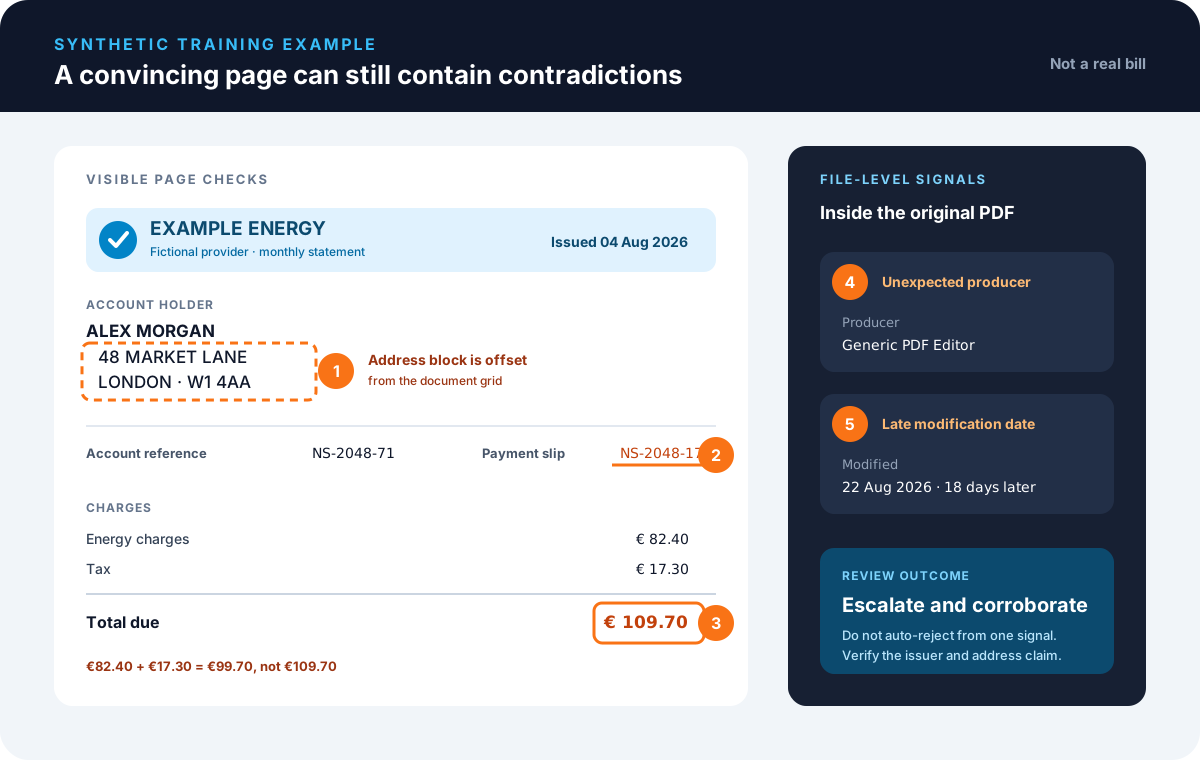
| Fonts and spacing | Name and address against nearby account details | Replacement text may use a different weight, character width or baseline |
| Alignment | Columns, decimal points, margins and address blocks | A changed field may sit a few pixels away from the document’s grid |
| Repeated details | Header, payment slip, footer and reference section | One copy of the old address or account number may remain |
| Dates | Issue date, billing period, due date and transaction dates | The sequence should make sense as one document |
| Arithmetic | Line items, tax, balance brought forward and total due | Edited amounts may stop reconciling |
| Issuer details | Domain, phone number, postal address and payment instructions | Details should agree with the issuer’s official channels |
Inconsistent fonts are useful, but they are not a verdict. A provider may combine templates, replace a billing system or embed a fallback font for one language. Likewise, a slightly crooked scan tells you more about the capture method than the original file.
Arithmetic is stronger because it tests the document’s own story. On a bank statement, recalculate the running balance around any suspicious line. On a bill, check whether usage charges, tax, credits and the amount due reconcile. When the numbers fail, ask for the original file or supporting account evidence rather than trying to explain the error away.
Repeated fields are my favourite manual check because they are easy to miss during editing. Compare every version of the address, customer number and billing date. A changed header paired with an old payment slip is a concrete inconsistency that the applicant or issuer can resolve.
For a deeper look at the most common subtype, our analysis of fake utility bill warning signs covers the particular weaknesses of billing documents without turning this article into a utility-only checklist.
Check the original PDF for editing traces
The page is only one layer of evidence. If the applicant received a digital bill or statement, ask for that original PDF rather than a screenshot, phone photo or print-and-scan copy.
Inspect these file-level signals together:
- Creator and producer fields. Do they fit a document generated by the named issuer, or do they point to a general editing tool? An unexpected value is a question, not proof of tampering.
- Creation and modification times. Compare them with the issue date and billing period. Time zones, later downloads and legitimate processing can create differences, so context matters.
- Fonts and content objects. A changed field may introduce a second font subset or a separate text object with different positioning.
- Layering and image regions. Added text or a replacement patch may sit above the original page content. Flattening can also come from an innocent scan or export.
- Consistency between visible text and extracted content. A field that looks right on screen may be encoded differently from the surrounding text.
PDF metadata is supporting evidence, not an authenticity certificate. Metadata can be absent, rewritten or stripped by normal software. A producer value such as Adobe Acrobat does not prove fraud because legitimate issuers also use common PDF tools. The useful signal is the combination of file history, structure and content, viewed against what the issuer normally provides.
This is also why intake design matters. Our post on why screenshots weaken document forensics explains what disappears when an original PDF is converted to pixels. If a customer only has a paper document, accept the scan as an exception and use other evidence to compensate. Do not pretend the lost file history can be recovered.
If your team already collects original PDFs but cannot inspect these signals consistently, see how document fraud detection software checks file structure and metadata. The page shows the available checks, workflow options and the free-check route, so you can decide whether automation fits before changing your onboarding process.
Verify the address claim, not just the PDF
A technically clean file can still support a false address. Someone may submit a genuine bill belonging to another person, use a real document from an old home or create a polished file with no obvious editing traces. File analysis therefore needs a separate claim check.
Compare the name and address with the application, identity document and any other independently obtained records. Look for small differences as well as direct contradictions: an old postcode, a unit number that appears only once or a mailing address presented as the service address.
Next, test the surrounding facts:
- Does the named provider plausibly serve that location? Treat this as a plausibility check, not proof of occupancy.
- Has the same address appeared across unrelated applicants or accounts? Reuse can indicate a shared template, mail drop or organised fraud pattern.
- Do property type, occupancy and other application details contradict the document? A contradiction is a reason to investigate, not an automatic rejection.
- Can the issuer confirm the account or document through an approved channel? Get the contact route from the issuer’s official website or a trusted database, never only from the submitted file.
Where a reliable registry, bank connection or other authoritative source is available and lawful for the use case, use it. The strongest outcome is agreement between the original file, the rest of the application and an independent source.
Which proof-of-address documents need different checks?
Utility bills
Compare the service address with the mailing address, then check the billing period, account reference and payment section. Consumption figures should be internally consistent, but do not infer fraud from high or low usage alone. Vacancies, estimated readings and tariff changes can produce surprising bills.
Bank statements and bank letters
Reconcile balances around edited-looking transactions and compare the address wherever it repeats. Verify contact details through the bank’s official website, not the phone number printed on the submitted document. Do not treat a familiar bank logo as evidence of origin.
Council tax and municipal letters
Check the authority name, property reference, covered period and payment instructions. Formats can vary by authority and year, so compare against current material from the issuing body rather than a random image search.
Tenancy agreements
Confirm that the parties, property address, dates and signatures agree throughout the agreement. A tenancy contract may support an address claim, but it is not independent evidence when the counterparty cannot be verified.
What manual review cannot tell you
Manual checks are useful for contradictions, arithmetic and obvious edits. They are weaker when a fraudster starts with a genuine file, makes a careful change and preserves the original design. They can also generate false alarms when a legitimate provider changes templates or uses unusual software.
The broader fraud trend is real, but it should not be misquoted as a proof-of-address fraud rate. Entrust’s 2025 Identity Fraud Report, based on remote identity-verification activity observed in 2024, says digital forgeries represented 57.46% of the document fraud in its dataset, up from 16.7% the previous year. That dataset covers document fraud across identity onboarding. It does not tell us what share of proof-of-address documents are fake.
There are three practical limits to keep in mind:
- A red flag is not a conviction. Escalate it and ask for corroboration.
- A clean-looking PDF is not proof of authenticity. Some edits leave little visible evidence.
- Forensic analysis does not replace business checks. Confirm the issuer, applicant and underlying account when the decision carries material risk.
Use automation to prioritise review, not to remove judgement. A risk result should tell an analyst where to look and which warnings produced the result. Borderline documents still need context.
A practical intake decision
Start by preserving the best evidence. Request the original digital PDF when one exists, keep it unchanged and compare its content with the rest of the application. If visible details conflict, arithmetic fails or file-level signals do not fit the claimed origin, pause the decision and seek independent confirmation.
Want to test that process on a real proof-of-address PDF? Run a free document check to receive a risk result and the warnings behind it. Use the result as a review aid, then confirm any material decision with the issuer or other independent evidence.